

Catch the error before you pay it
Recovering an overpayment takes months of claims and chasing. Refusing the invoice takes one click, if the error is visible before payment. Our Invoice Approval module puts the audit in front of the payment run rather than behind it.
Why does the timing matter so much?
A credit note is a negotiation. A rejected invoice is not. Once you have paid, the money is the carrier's and you are asking for it back with whatever leverage you have. Before payment you simply decline and the carrier reissues.
Most finance teams need both routes. Correct invoices are approved for payment. Incorrect ones are rejected and reissued by the carrier rather than paid and then claimed back.
The money is the carrier's. You claim it back with whatever leverage you have.
You reject the invoice and the carrier reissues a corrected one.
What does the approval workflow look like?
Your team reviews the exceptions rather than reading every invoice. We match each invoice to its shipment, rate card and route, and surface anything that does not fit: overpayments, charges with no contracted rate, and items we cannot audit at all.
What happens to charges with no rate card?
They are shown, not hidden. An uncontracted line item appears as a visible overpayment rather than a silent “no tariff” exclusion. That matters because uncontracted charges are where the money leaks. Our ocean freight audit found EUR 562,000 a year of uncontracted terminal storage that nobody had rated.
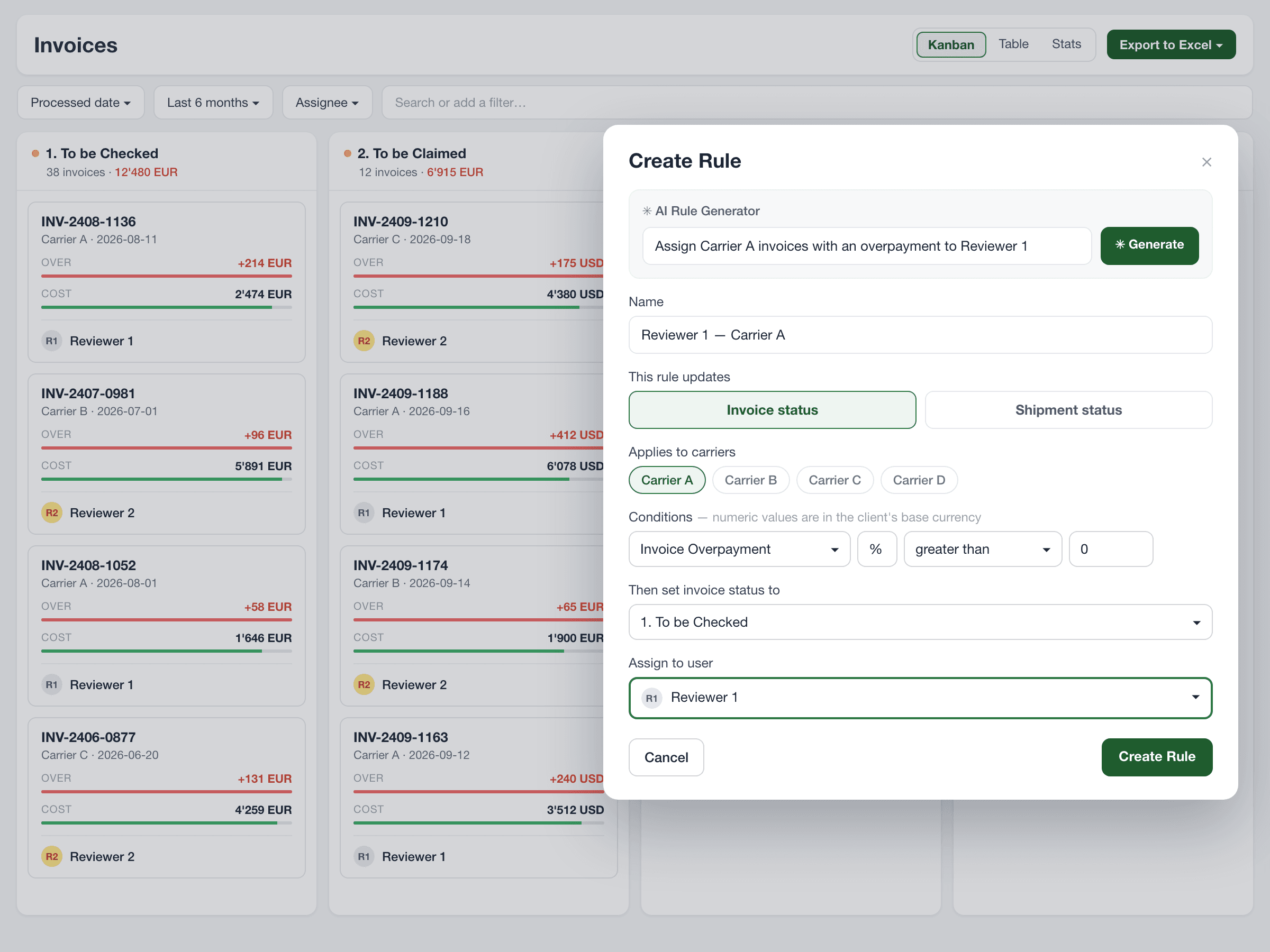
Can we route invoices to the right reviewer?
Yes. We route invoices by region, country or individual, so each person sees only the invoices they are responsible for. A team in Latin America sees Latin American invoices and nothing else.
Every decision, comment and claim sent to a carrier is recorded, so you keep a complete audit trail without anyone maintaining one.
What about accounting assignment?
Our Kontierung module automates the accounting assignment of freight invoices so approved costs post into your financial systems without manual coding.